By the time Yeheshuah reaches the cross, the decision has already been made.
Gethsemane was the place of doubt. There he had confronted the possibility that everything he had spent his life discovering might be wrong. He had chosen nevertheless to continue.
But choosing death and dying are not the same thing.
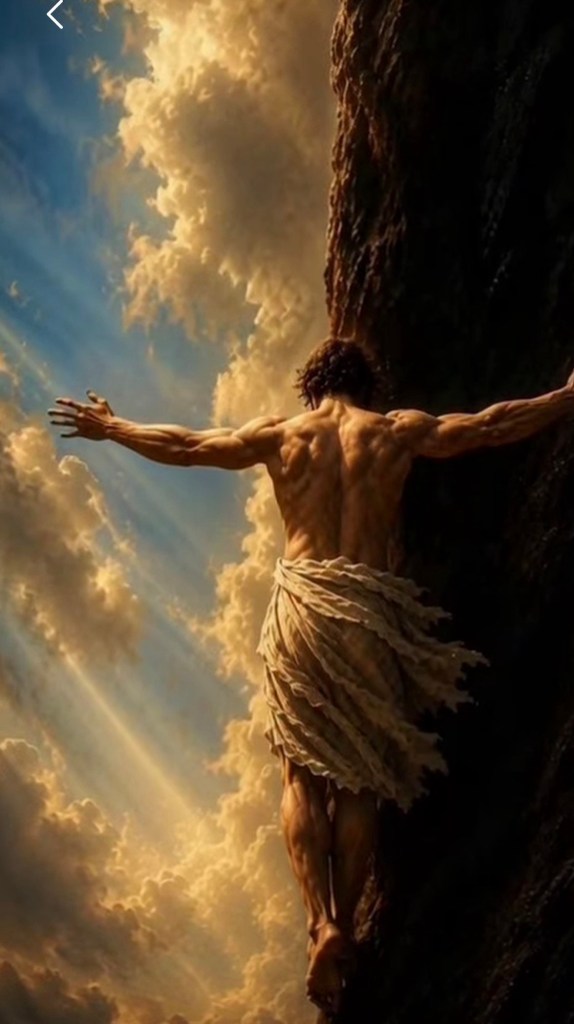
On the cross, philosophy becomes flesh.
The man who has spent his life learning to overcome separation is now subjected to everything capable of forcing a human consciousness back into it: humiliation, agony, terror, helplessness, grief and rage.
And beneath him stands Magdalene.
She is pregnant with their child.
She is also, symbolically, the seamless garment: the thing woven whole, without division. She embodies in miniature the truth Yeheshuah has spent his life trying to understand.
One containing another.
Two lives within one body.
Multiplicity held within unity.
Then, at the foot of the cross, while Yeheshuah is physically incapable of reaching her, Magdalene is raped and murdered.
He watches.
He cannot climb down.
He cannot protect her.
He cannot protect their unborn child.
The man who has trained himself to encompass creation within himself experiences something entirely human.
Rage.
Not gentle disappointment. Not supernatural detachment.
Fury.
Inside him he is screaming.
Everything in him wants to condemn the men responsible, to separate them from himself, from Magdalene, from everything he loves. He wants them punished. He wants them to suffer.
And in that instant Yeheshuah comes perilously close to destroying the very state of consciousness upon which everything depends.
Because hatred requires an other.
For his entire life he has been moving towards the opposite realization: there is no absolute separation. Creation is One. Everything exists within everything else. He has prepared himself to carry the whole of creation through death.
But whole means whole.
He cannot carry Magdalene and exclude her murderer.
He cannot carry the innocent and abandon the guilty.
He cannot proclaim that everything is One and then, when unity becomes unbearable, divide creation back into us and them.
This is no longer mystical theory practised safely in meditation.
This is the final examination.
And so, while everything human within him is raging:
“Father, forgive them, for they know not what they do.”
The words are not evidence that Yeheshuah feels no anger.
They exist precisely because he does.
He is fighting for his alignment.
He is refusing to allow hatred to tear apart what he has spent his life making whole.
And below him lies the seamless garment.
Magdalene is dying.
Their eyes meet.
In that instant, the great cosmic principle Yeheshuah has struggled to understand throughout his life becomes intimate.
Magdalene carries their child within herself.
And Yeheshuah carries Magdalene within himself.
She contains the child. He contains her. Therefore he contains them both.
The microcosm is complete.
He cannot prevent Magdalene’s physical death, but neither does he experience her as disappearing into nothingness. In their final gaze, separation fails.
She remains within him.
The child remains within her.
And shortly afterwards Yeheshuah will attempt the same thing on an unimaginable scale.
He will carry Creation itself.
Magdalene therefore does not merely witness the crucifixion.
She becomes part of its architecture.
She demonstrates the principle in miniature immediately before Yeheshuah must enact it universally.
She carries one life through her own.
He will carry every life through his.
She goes first for him.
He goes first for everyone.
But the ordeal is not finished.
Yeheshuah has survived rage without allowing it to become separation.
Now his own body begins to defeat him.
Pain strips consciousness down.
Breath becomes difficult. His strength disappears. The meditative discipline he has spent decades developing becomes almost impossible to maintain.
The extraordinary state in which he has experienced himself as inseparable from Creation begins to collapse.
Then something even more frightening happens.
He can no longer feel the presence that has guided him.
The Father.
The Source.
That strange intelligence he has encountered throughout his life—the presence he does not yet understand is his own completed, future consciousness—is suddenly silent.
And the human being on the cross panics.
“Eloi, Eloi, lama sabachthani?”
My God, my God, why have you forsaken me?
No answer comes.
For perhaps the first time in years, Yeheshuah experiences absolute separation.
He is no longer the mystic who contains the universe.
He is simply a terrified, dying man nailed to a piece of wood.
And the worst possibility from Gethsemane returns.
Perhaps he was wrong.
Perhaps there never was a Source.
Perhaps the voice was imagination.
Perhaps there is nothing waiting beyond death.
Perhaps he has mistaken his own mind for God.
The terrible irony is that part of this fear is correct.
The voice was him.
But not the dying Yeheshuah.
The presence he has experienced as Father is what Yeheshuah will become only if he completes the passage he is now terrified to complete.
He is calling out to his own future.
And in his moment of greatest suffering, he can no longer hear it.
This is the final test.
Not pain.
Not death.
Not even grief.
Separation.
Yeheshuah has forgiven others while experiencing rage.
Now he must rediscover unity while experiencing abandonment.
There is no miraculous voice from heaven to rescue him.
No external Father tells him that everything will be all right.
He has to find his own way back.
Somewhere inside the agony, Yeheshuah remembers.
Everything he has learned.
Everything he has experienced.
Everything he has become.
Magdalene is within him.
Their child is within her.
Creation is within him.
Even the men responsible for the horror beneath the cross remain part of the whole.
Nothing has actually separated.
Only his ability to perceive the unity has failed.
Slowly, he realigns.
And then:
“It is finished.”
Not merely:
My life is finished.
The work is finished.
The alignment is restored.
The containment is complete.
He has held Creation together despite everything capable of tearing it apart.
There is nothing more he can learn.
Nothing more he can prepare.
Nothing more he can control.
Only one thing remains.
Surrender.
And so the frightened human being who has spent his entire life searching for the Father entrusts himself to something whose existence he still cannot finally prove:
“Father, into your hands I commend my spirit.”
It is not certainty.
It is trust.
That distinction is everything.
If Yeheshuah knew beyond doubt that resurrection awaited him, there would be no final leap. He would merely be completing a predetermined journey.
Instead, he dies as a human being.
He has been furious.
He has grieved.
He has doubted.
He has felt abandoned.
He has briefly lost the very unity upon which his life’s work depends.
And he has found it again.
He does not overcome fear by discovering that there is nothing to fear.
He overcomes fear by accepting that he cannot know what happens next.
He trusts while afraid.
And then he lets go.
Magdalene is within him.
Their unborn child is within her.
Humanity is within him.
The guilty and the innocent are within him.
Creation is within him.
Nothing has been excluded.
Nothing has been torn away.
The seamless garment remains whole.
And carrying everything with him, Yeheshuah dies.
The man falls towards zero.
The universe falls with him.
And somewhere beyond the boundary he cannot yet see waits the consciousness he has spent his whole life calling Father.
The hands into which he has entrusted himself are waiting.
They are his own.
 The Truth About Yeheshuah
Leave a comment